
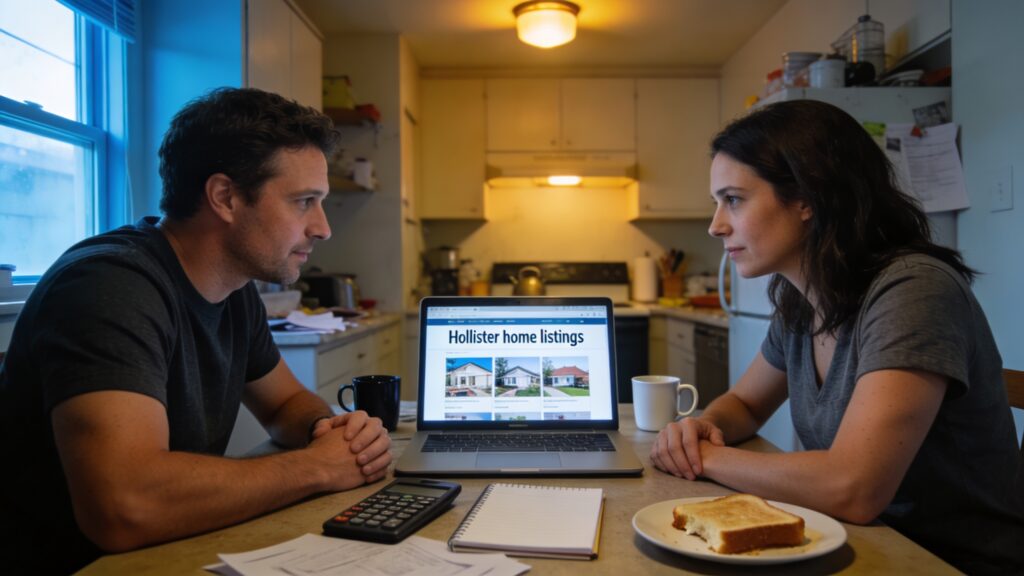
Silicon Valley Remote Workers Are Building Equity in Hollister—Here’s What the Numbers Actually Say
That 90-minute commute to Cupertino isn’t looking so appealing anymore, is it? If you’re working remotely from Silicon Valley and watching your rent eat 40% of your dual income while starter homes hit $2 million, you’re probably wondering if there’s a smarter play than staying put and hoping for a miracle.
The honest answer? Hollister might be exactly what you’re looking for—but only if you understand what you’re actually buying into. As a husband-wife team living in the Hollister market, we’ve watched dozens of Bay Area transplants make this move over the past two years. Some nailed the timing and built serious equity. Others jumped too fast and learned expensive lessons.
Here’s what the numbers actually say about Hollister’s real estate trends for first-time buyers coming from Silicon Valley, plus the trade-offs nobody talks about until after you’ve signed papers.
The Price-Per-Square-Foot Reality Check
Let’s start with the math that probably brought you here. While Silicon Valley median home prices hover around $1.8-2.2 million, Hollister’s median sits closer to $750,000-850,000 depending on the neighborhood. But the real story is in the price per square foot.
In San Jose, you’re looking at $800-1,200 per square foot for anything decent. In Hollister? We’re seeing $350-450 per square foot for comparable quality homes. That means the 1,200 square foot condo that costs $1.4 million in Mountain View becomes a 2,400 square foot single-family home with a yard in Hollister for $900,000.
The absorption rate tells an interesting story too. Single-family homes in the $700,000-900,000 range are moving within 30-45 days when priced correctly, compared to 60-90 days this time last year. That’s not a red-hot seller’s market, but it’s steady demand from buyers who’ve done their homework.
What’s driving this? Remote-flexible tech workers, mostly. We’re seeing software engineers, product managers, and consultants who realized they can keep their Silicon Valley salaries while cutting their housing costs in half. The math works when you’re not commuting daily.
Inventory Trends That Actually Favor Informed Buyers
Here’s where timing matters more than most people realize. Hollister’s inventory has been sitting in a sweet spot for buyers who understand seasonal patterns. We typically see 2-3 months of inventory during peak season (spring/summer), which gives you negotiating room without the feeding frenzy you’d face in Palo Alto.
The key insight most Bay Area transplants miss? Hollister sellers often price based on outdated comps or wishful thinking rather than current market conditions. We’ve seen well-positioned buyers negotiate 3-5% below asking on homes that sat for 60+ days because the seller didn’t understand local absorption rates.
But there’s a catch. The best inventory—homes in Santana Ranch, near Ridgemark Golf Course, or the newer developments off Leal—moves fast when priced correctly. These neighborhoods attract the same remote workers you’re competing with, so you need to be ready to move when the right property hits the market.
The mistake we see repeatedly? Bay Area buyers who think they can take their time because Hollister “isn’t competitive.” Wrong. The right homes in the right neighborhoods absolutely are competitive, just not at Silicon Valley speed.
The Equity Play Everyone’s Missing
This is where most articles would tell you “it’s always a great time to buy.” That’s garbage. But there is a legitimate equity opportunity in Hollister that remote workers are capitalizing on—if they understand the fundamentals.
San Benito County has been undervalued relative to surrounding markets for years. While Gilroy and Morgan Hill saw massive appreciation during the pandemic, Hollister lagged. That lag is closing. We’re seeing 8-12% appreciation year-over-year in desirable neighborhoods, which is sustainable growth rather than bubble territory.
The demographic shift supports this trend. Young families priced out of Santa Clara County aren’t just looking at Tracy or Stockton anymore. Hollister offers small town feel with reasonable access to Silicon Valley when needed, plus outdoor recreation that Pinnacles National Park and local vineyards provide.
But here’s the honest context: this equity play works best for buyers planning to stay 5+ years. If you’re thinking this is a 2-year flip to get back to Mountain View, you’re probably making a mistake. Transaction costs and market timing could easily eat any short-term gains.
When Waiting Makes More Sense Than Jumping
Not everyone should buy in Hollister right now, despite what commission-hungry agents might tell you. If you’re still commuting to Silicon Valley 3+ days per week, the math gets ugly fast. Gas, wear-and-tear, and time costs add up to $800-1,200 monthly, which erases much of your housing savings.
If you need urban amenities—walkable restaurants, cultural events, diverse dining—Hollister’s tight knit community might feel limiting. We love the motorcycle rally and local vineyards, but let’s be honest: you’re not getting San Francisco’s restaurant scene or San Jose’s entertainment options.
The school situation requires research too. Hollister has solid elementary and middle schools, but high school options are more limited. If you have teenagers or plan to, factor that into your timeline.
Market timing matters as well. If inventory jumps significantly (we’d be watching for 4+ months of supply), or if interest rates spike above 8%, waiting 6-12 months could save you $50,000+ on purchase price. We track these metrics weekly and give our clients honest assessments, even when it means delaying a purchase.
Making the Move Work for Your Situation
The Bay Area transplants who succeed in Hollister share common characteristics. They’re genuinely remote-flexible, not just temporarily working from home. They value space and community over nightlife and convenience. And they understand they’re making a long-term equity play, not a quick arbitrage.
The process works best when you visit multiple times, in different seasons, to understand what daily life actually feels like. Drive the commute during rush hour if you’ll need it occasionally. Spend time in downtown Hollister, visit the local coffee shops, check out the Saturday farmers market.
Most importantly, work with someone who lives in the market and will tell you the truth about timing, neighborhoods, and trade-offs. As your local expert team in San Benito County, we’ve guided dozens of families through this transition successfully—and talked others out of moves that didn’t make sense for their situation.
The Hollister market offers real opportunity for remote-flexible Silicon Valley workers ready to build equity while gaining space and reducing stress. But like any investment, it works best when you understand what you’re actually buying and why the timing makes sense for your specific situation. If you’re considering the move and want an honest assessment based on current market conditions and your particular needs, we’re here to help you think through the decision without the sales pressure. Reach out at 831-902-0472 or israel@ighomes.com—we’d rather give you straight answers now than deal with regrets later.